
Material handling hoses are crucial equipment in the industrial setting for moving a range of materials, including gases, liquids, and abrasive solids like dust, grit, and chips. Their longevity has a significant impact on long-term cost effectiveness, maintenance frequency, and operating efficiency. However, what does the term “durable material handling hose” actually mean? Furthermore, what kind of hose is most appropriate for demanding uses? We explore the physics behind long-lasting hoses and illustrate important design concepts and material choices with examples from everyday life.
What is Durable Material Handling Hose?
A material handling hose’s durability goes beyond simply being “tough.” Its ability to sustain a certain load while retaining its structural integrity is what matters. Important elements consist of:
The ability of the hose to tolerate friction with hard, sharp objects (such sand and metal shards) that erode the hose wall over time is known as abrasion resistance.
- Chemical and Environmental Resistance: Guards against oil, chemicals, UV radiation, ozone, humidity, and other environmental factors. The hose may develop cracks, expand, or deteriorate as a result of these exposures.
- Structural Integrity: Even after repeated bends and stretches, reinforcements like coils and wires keep the hoses from bending, breaking, or collapsing under pressure or vacuum.
- Flexibility and Durability: Because hoses are made to bend easily, they lessen the wear and tear that comes with continuous motion in industrial settings.
Examining Different Types of Durable Hoses for Material Processing
Different kinds of hoses are needed for various industrial purposes. Let’s examine several popular heavy-duty hose options in more detail to understand how their construction and materials affect their longevity.
1. Polyurethane (PU) Steel Wire Spiral Hose
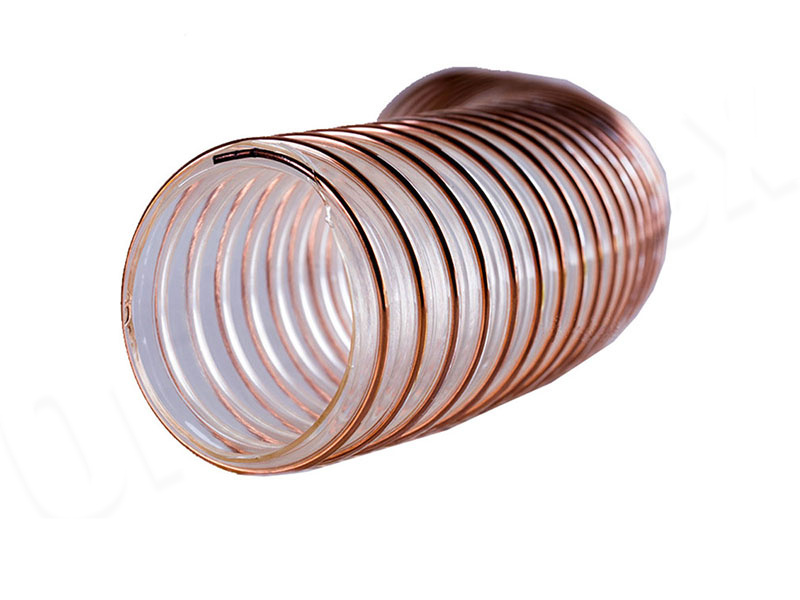
Polyurethane (PU) steel wire spiral hoses offer excellent durability, especially under abrasive and changing conditions.
How They Work:
Polyurethane (PU), a sturdy polymer reinforced with a flexible steel spiral, is used to make these hoses. Typically, walls are between 0.4 and 1.5 mm thick, while thicker choices (1.2 to 1.5 mm) are available for heavy-duty applications.
Factors Affecting Durability:
- Materials: Using premium polyurethane—typically polyester or polyether—is crucial. Polyester-type polyurethanes, for instance, are perfect for usage in wet environments like cement and stone manufacturers because of their exceptional hydrolysis resistance (they do not readily dissolve even in wet situations) and antibacterial qualities.
- Resistance to Abrasion and Chemicals: Because of its exceptional tensile and tear strength, polyurethane can tolerate friction from abrasive materials like shattered glass, gravel, and sand. In order to avoid swelling and cracking, it is also resistant to industrial chemicals and mineral oils.
- Construction: For increased strength and flexibility, a flexible steel spiral is incorporated into the polyurethane wall. Even at tight bends, its spiral structure keeps the hose from bending, and it may be expanded and contracted (usually in a 3:1 ratio) without breaking.
- Environmental Protection: The hose is shielded from harsh and industrial conditions by UV and ozone-resistant coatings, which stop it from cracking over time.
Main Applications:
These hoses work especially well for ventilation and exhaust control in dusty settings like woodworking and pottery factories, as well as high-flow abrasive materials like glass manufacturing, stoneware, and ports.
2. Durable Antistatic Hose
Various industrial products, including wood chips, grain, and plastic pellets, generate static electricity when flowing through hoses. In these situations, antistatic properties are crucial to hose durability, as static buildup can damage the hose and even cause a fire.
How it works:
These hoses typically feature a robust spiral reinforcement structure and a wall made of a unique polyester polyurethane that typically meets DIN ISO 4649, the standard for abrasion resistance for hoses. The wall is made of PVC, with thicknesses ranging from 0.6 mm to 2.0 mm, providing both flexibility and protection.
Durability Factors:
- Greater Abrasion Resistance: According to DIN ISO 4649, polyurethane is made to endure constant friction with fibrous or granular materials and is more abrasion resistant than ordinary polyester polyurethane. The smooth inner wall minimizes wear by avoiding friction and material buildup. Antistatic Design: To safely discharge static electricity (surface resistance less than 10⁸ ohms), a stiff spiral of steel or PVC wire is frequently linked to ground. By doing this, static sparks are kept from destroying the hose’s substance and starting fires.
- Chemical and Environmental Resistance: Plasticizers and halogenated compounds, which can degrade over time, are often absent from these hoses. Their usable life is increased by this design’s improved resistance to ozone, chemicals, and oil.
- Resistance to Pressure and Vacuum: Robust structural reinforcement resists pressure and suction (vacuum), avoiding rupture or fracture while in use.
Applications:
Perfect for dust collecting systems in stone handling, grain handling, woodworking, and other fields requiring both strength and static safety.

3. PVC Steel Wire Reinforced Conduit: Versatile and Durable
PVC steel wire reinforced conduits provide the ideal combination of strength, flexibility, and affordability for applications that don’t need harsh conditions but still need some strength (such handling tiny particles, gasses, or liquids).
How They Work:
A PVC-coated steel wire helix reinforces the flexible PVC wall of these conduits. Steel wire gives them strength, while the lightweight PVC makes them manageable.
Durability:
- Flexibility and Bend Resistance: These conduits can bend without bending thanks to the flexible PVC and steel wire mix, which lessens wear from frequent storage and transportation.
- Chemical and Environmental Resistance: PVC is appropriate for a range of industrial fluids because to its natural resistance to several acids, alkalis, and oils. After treatment, it also has a long lifespan in bright areas or outdoors by resisting UV rays. Smooth Internal Surface: By lowering adhesion and friction, the non-porous, smooth interior surface lessens abrasion from dust, grime, and tiny particles.
Applications:
These hoses are frequently found in air conditioning systems, industrial vacuum systems, and the transportation of tiny particles and gaseous media (such smoke and steam) in manufacturing facilities and industries.
Key Points: How to Choose Durable Hose for Material Handling
Adapting the hose construction to your unique requirements is crucial for material handling hose endurance.
- For abrasive solids such as sand and gravel, choose a robust polyurethane hose reinforced with a polyester-based polyurethane for hydrolysis resistance.
- For handling static-prone materials such as dust and grain, choose an abrasion-resistant antistatic hose equipped with a polyurethane spiral ground wall that meets DIN standards.
- For general applications handling small particles and gases, PVC steel wire reinforced hose offers durability, flexibility, and proven cost-effectiveness.
You can select the best hose for your industrial setting by knowing how construction features (like wall thickness and antistatic ground connection), reinforcements (like steel wire or PVC helix), and materials (like polyurethane or PVC) impact durability. This will ensure long life and minimize maintenance issues.